
Nexus Circular is an advanced recycler using a patented pyrolysis technology to convert unrecyclable plastics back into a high-value liquid feedstock. The company is expanding its operations and opening facilities in partnership with chemical manufacturing giants.
How has the advanced recycling industry been changing in recent years?
Advanced recycling has been dynamic. We have seen a slow, steady acceptance of these nascent technologies along with growth in demand. Five or six years ago, when we were commissioning our first commercial site, brands were making voluntary sustainability commitments. Today, companies are realizing a shift toward regulatory compliance with the implementation of Extended Producer Responsibility (EPR) programs. Mandates are new and different for this industry and for the United States – we do not like being told what to do, which is why there are so many lawsuits and pushback. This is creating uncertainty around plastic packaging conformity, fees and which parties are responsible while at the same time, everybody is also trying to understand the new requirements for compliance.
What is the significance of being classified as a manufacturer?
Within the last 5 years, 25 states have implemented new legislation to classify advanced recycling as manufacturing instead of incineration or solid waste management. Both sectors are regulated by the Clean Air Act with manufacturing following a permitting path that is equally as robust but more straight-forward, making it much clearer and less risky for companies to locate in those states. Now, we are seeing movement at the federal level to standardize the classification of advanced recycling as manufacturing through the introduction of the Recycling Technology Innovation Act (RTIA) as well as through revised regulations by the Environmental Protection Agency. Federal reclassification would eliminate uncertainty and make investment decisions much easier.
How does Nexus Circular’s recycling technology work?
People pay companies to remove their waste. We do not handle waste. We pay our suppliers for used plastic feedstock. This way the supplier knows the plastic has value and we can have more control over what we bring into our facilities.
Then we convert the plastic into a new material by a process called pyrolysis, which heats to ~400 degrees Celsius in a closed system without oxygen, conserving the plastic resource and returning it to the supply chain. Incineration is a completely different process that happens at over 1400 degrees Celsius, adds oxygen, which burns and consumes the plastic. We do not want to burn valuable post-use plastic. Our goal is to recover and return plastic to the supply chain to create new materials.
Advanced recycling is critical to U.S. energy independence. A primary outlet for fossil fuel is plastics production. Stretching supplies to go further and reusing resources just makes a lot of sense.
Where does Nexus source its feedstock?
We are a big proponent of complementing existing recycling technologies, and focus on film, flexible packaging, foams and other unusable, unwanted materials that get caught and left over in mechanical recycling systems. This includes shrink wrap from bulk wrapping, flexible packaging and plastics contaminated by dirt, food or oils.
For example, your Polyethylene Terephthalate (PET) water and soda bottles are mostly going to be mechanically recycled. High-density polyethylene detergent bottles that can be washed will work perfectly for mechanical recyclers. But if that bottle held motor oil, a mechanical recycler cannot handle that residual contamination, but Nexus’ recycling process can, so that’s how our process complements traditional mechanical recycling.
We work directly with companies generating this type of used plastic packaging –auto manufacturers, food plants and people doing secondary sorting with equipment to sort film. When film plastic does not have a home after being sorted, we take it. It is a win-win-win for Nexus to secure a steady supply of used plastic feedstock, for the supplier to meet their zero waste to landfill and sustainability goals and for the environment to reduce the plastics needing to be managed in landfills.
How does your recycling process work?
Plastic starts with a monomer, like ethylene or propylene. I am a mechanical engineer, so I like to think of what happens next as using those monomers (individual Lego bricks) to build a huge molecular Lego tower called polyethylene, the plastic for milk jugs or the plastic packaging for your paper towels. The Nexus process converts that plastic back down into an oil that we sell as a direct substitute for a fossil-based material called naphtha that is then used to create those monomers as building blocks for plastic.
Our pyrolysis oil must meet stringent quality parameters to be used directly by our customers – they do not want certain components such as chlorine or nickel in their products. We have a mechanical sorting plant alongside our specialty chemical manufacturing plant that converts plastic into our pyrolysis oil. The combination of this equipment allows us to consistently meet customer specifications and eliminate the pre- or post-treatment of our products so they are ready for use for offtake partners’ existing assets. For example, the “C” in PVC is chlorine, so we are able to sort and remove PVC from our incoming feedstocks, like construction pipe, to ensure we meet our customer’s quality requirements.
Cox Enterprises, our major investor, provides us with data collection and AI resources we might not have access to otherwise. We set up our first commercial plant in Atlanta with significantly more data collection points than required for a regular manufacturing site to optimize our processes at all our plants going forward, with a whole team devoted to this. In the last two years, we have been getting enough from our data to understand how to handle a wider range of plastic feedstocks and to optimize our process.
What do you see in the future for advanced recycling, and what role do partnerships play in Nexus’s growth?
We work closely with partners including Chevron Phillips Chemical, Braskem, Shell and LyondellBasell. Putting steel in the ground to build new capacity is expensive and needs a payback within a decade or so. So, our offtake partners’ willingness to commit to long-term contracts makes it possible to invest in new facilities. We have our commercial facility in Atlanta and another in Georgia being built in two phases. We also launched a licensing strategy to expand our global footprint through partners because there is simply too much post-use plastic out there for an individual company to handle alone. With licensees who want to put steel in the ground at the same time as Nexus is building our own facilities, we can keep more plastic out of landfills.
A lot of advanced recycling companies have not been able to survive uncertainty, not because their technologies do not work but because new technologies need time to reach commercial scale. To invest in more time, we have to be certain that there is a strong market with sustained demand through economic cycles.
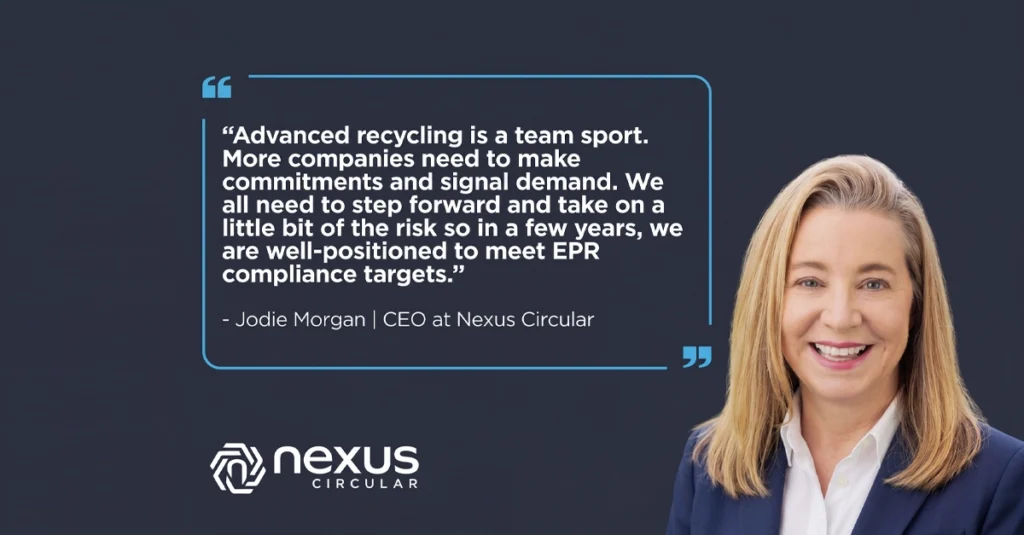
Advanced recycling is a team sport–it is our future and everybody has a part to play.
More brands and companies in the plastics value chain need to make commitments and signal demand. If we wait to build the infrastructure, we will not be ready when companies most need the post-consumer recycled content to meet compliance targets in EPR legislation. We all need to step forward and take on a little bit of the risk so in a few years, we are well-positioned. Collecting plastic without a way to reprocess the product simply makes expensive collected trash with nowhere to go but to a landfill.